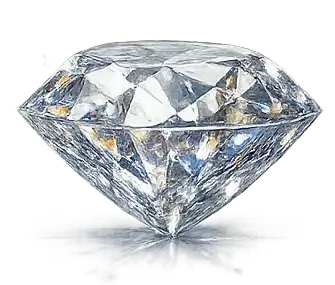
Diamond
The Gem Stone of Venus
Diamond possesses indigo-blue cosmic rays. It is a cold gemstone ruled by Venus. It empowers people to attract and promotes good understanding.
It cures sexual disorders, delirium, diabetes mellitus, paralysis, and syphilis. It increases intellect and ensures the luxuries of life.
Diamonds have great brilliance, plus the delightful quality known as fire or dispersion — the ability to take in white light and throw back flashes of color.
About Diamond
Diamonds are our most popular gem. They have great brilliance, plus the delightful quality known as fire or dispersion — the ability to take in white light and throw back flashes of color. Diamonds are graded on four qualities: Color, Clarity, Cut, and Carat.
The closer a diamond is to being colorless, the greater its value. Colors D, E and F are the highest grades described as ‘near colorless.’ The clarity is determined by the size and number of inclusions, with Flawless being the highest grade.
The ideal angle for diamond pavilion facets is 41 degrees. A well-cut diamond maximizes brilliance and fire. As a rule, it is usually best to go with quality rather than size.
Value & Rarity
Smaller diamonds are more common than large ones, so smaller diamonds cost less per carat. A diamond costing $900/ct at ½ carat might cost $4000/ct at a full carat.
Diamonds in the white range of color (G, H, I or J) with clarity grades SI1 or SI2 are visually wonderful — bright, lively, and dazzling. Most people will get more enjoyment from a higher quality dazzler than a larger but mediocre gem.
You should spend six months income on an engagement ring. I know that, I heard it on television! For a salesman that is a great idea. However, picking a diamond is something much more personal than finances.
Economics vary from person to person and family to family. I wouldn’t presume to advise you on how much you can afford, but I can help you wade through the morass of grading information and put it in common language.
As a rule, I suggest diamonds that are in the white range of color, (G, H, I or J,) and those with clarity grades SI1 or SI2. Visually these are wonderful diamonds. They are bright and lively they will dazzle all your friends!
You might consider a lower grade of color if the right deal was presented to you. An L graded diamond can look white in a yellow gold setting and be quite brilliant. The fact that it costs less per size might be worth your while. I wouldn’t recommend looking for this grade, but if you found one in a setting that you really love it would be worth serious consideration.
Going down in clarity grading can occasionally be worth your while too, depending on the individual diamond and setting. Sometimes the “eye visible” inclusion that got it that ranking is insignificant and the overall appearance is still delightful.
Going down further in quality is rarely worth while. I know a lot of jewelers make their living by supposedly underselling the competition, when in fact they are selling lower grade gems. Without better quality diamonds near by to compare with, the customer is often convinced they are getting a great deal. The diamonds sparkle, the price and terms are just, oh, so sweet!
The disappointment comes later. Imagine your fiancée showing off her engagement ring, (something they usually get great joy out of,) only to find hers is dull compared to those of her friends. You no longer have a great deal. The enjoyment of the diamond goes way down when you compare a lower quality gem to a good one.
Please consider this factor carefully! While choosing a diamond is a personal thing and not everyone will have the same opinion, most folks will get more enjoyment from a higher quality dazzler, than a larger but mediocre gem.
How about going up in quality? That is a personal matter. If you get an emotional boost from owning the biggest and the best and can afford it, then you certainly should. However, for most people who simply want a fine gem on their finger, it isn’t necessary.
People who are serious about their diamonds and get to look at a lot of them, get a real joy out of finding those rare gems that are nearly colorless or nearly clean under magnification. These gems are much rarer and therefore demand a higher price. But that does not mean they are much prettier, nor does it mean that you will get more enjoyment out of them.
If you were to set two well cut diamonds side by side, one graded D, VVSI1 and the other G, SI1, you would see very little, if any, difference with the naked eye. You would have a strong emotional reaction when you heard the prices though!
The point is simple, these are the rarest quality gems and the difference is only apparent to the sophisticated diamond appraiser who inspects them carefully with magnification.
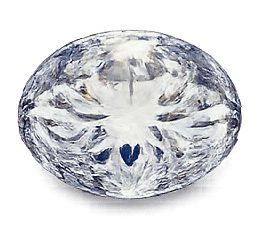
There is occasionally a difference between a diamond graded SI1 and SI2. (SI1 is defined as “small inclusions, somewhat easy to find.” SI2 is defined as “small inclusions easy to find.”) When I look at a gem graded SI1 I usually see something like the first illustration. One or two tiny dark spots that have no effect on the brilliance of the gem.
Those graded SI2 have inclusions placed near the center where they are more visible, or many more of them. Some gems graded SI2, like the first illustration, will have no significant difference in brilliance. In an extreme case, where there are many inclusions, (even though none are large enough to be seen without magnification,) they may make up 5% or more of the visible area. That means a 5% or more reduction in brilliance.
One of the most important elements of a diamond’s appearance is the cut. This is a difficult element to judge. Diamonds are rarely cut to ideal proportions, but they have such high optical properties that most of them are still beautiful. Without getting overly technical, you can judge the quality of cutting by simply comparing diamonds side by side. Look for overall brilliance and fire; those little flashes of color. If the diamond you are considering does not have the sparkle of the other gems, then keep looking.
To summarize, it is usually best to go with quality rather than size, but if your budget is limited the rarest qualities may not be worth your money.
Why Wear Diamond?
Ruled by Venus
Channels indigo-blue cosmic rays for attraction, luxury, and aesthetic refinement through Venus's energy.
Love & Attraction
Empowers people to attract love and promotes deep understanding in relationships.
Intellect
Increases intellectual capacity and ensures access to the luxuries and finer things in life.
Health & Healing
Helps cure sexual disorders, delirium, diabetes, paralysis, and promotes overall vitality.
Facts about Diamond
| Property | Value |
|---|---|
| Chemistry | C (Carbon) |
| Crystallography | Isometric |
| Refractive Index | 2.417 |
| Hardness | 10 |
| Specific Gravity | 3.515 |
| Cleavage | Perfect, 4 directions |
| Heat Sensitive | No |
| Wearability | Excellent |
| Special Care | None needed |
This food comes from the upper layer of the Earth. If we go further down into the Earth, you will find the roots which help us to survive. If we go down further into the Earth, then we discover the minerals which we need to survive. The most essential element of the above mentioned breakdown of the Earth is the concentrated form of energy or as is known by Vedic science, the essence of Earth…or gemstones.The right proportions of food, air, water, and heat give us life and energy. Similarly, the right gemstones will provide a harmonious and more improved life. You may say that you don’t eat gemstones but you do eat food. Gemstones work the same way that lightening effects you, or how the Sun ray’s give you Vitamin D, or how the sound of soothing music relaxes you. The aroma of onions will make you cry even though you don’t touch them. Gemstone energy works on your mind. When the mind is balanced, you will make less mistakes and you will have more time, money, and energy to construct a better future.
You may still argue as to how a piece of rock will help you. Take for example a knife made out of iron. However, when the doctor uses the knife with the right knowledge, that piece of iron becomes a life saving tool. Vedic Astrological Science is based on the physics of Nature and the chemistry of the Earth. Combining the five basic elements: Fire, Water, Air, Earth, and Cosmic Energy, you conclude at Vedic astrological gemstones. The more you harmonize with these energies, the better conductivity of success will develop within you and around you. Nature provides these elements, without which you cannot exist. Therefore Nature controls your every second. Furthermore, Nature inspires the mind, which in turn influences the body to act positively or negatively according to the harmony of cosmic energy and environment. Remember, we generate the right prescription based upon your own very unique birth place, date, and time of birth.
Nature will not come knocking on your door to help you. You must take advantage of this light and put it to work for a better future.
Please Note Vedic Gemstones also known as Jyotish Gemstones, Astrological Gemstones, Healing Gemstones, Holistic Gems, Navratna, Jyotish Gems, Planetary Gems, Birthstones.
By wearing properly prescribed gemstones under proper supervision, you can benefit from the natural healing characteristics of Vedic astrological gemstones. We do not recommend these Vedic astrological gemstones to be applied in lieu of necessary medical attention. By no means is this information a self-help panacea. However, we do recommend the application of Vedic astrological gemstones in efforts to reduce discomfort in a natural and time-demanding situation. One must remember that we are not qualified medical experts.
However, we have empirical evidence that utilizes the examination of your horoscope and family background for a prescription. Our ‘dosages’ are monitored and are based on the size and type of gemstones.The ancient scientific scriptures consistently mention the relationship between color, planets, and gemstones. With the almost sacred color stratification, ROYGBIV (Red, Orange, Yellow, Green, Blue, Indigo, Violet), we see the correlation perfectly. The cosmic rays that manifest themselves in various wavelengths (colors) have unique affects on the health of our mind and body. The purest of the ROYGBIV rays resides concentrated in precious gems, and so, the gems are of great curative value.
Diplomat, American Board of Pathology Posted St. Valentine's Day, 2000
What we are trying to illustrate here are the fundamentals of our human existence. If we were to mix the below mentioned amounts of elements into a doll, then would the doll come to life? Of course not! Then you must know that something else is affecting us, namely, prana (cosmic energy).
The table below gives the amount of each chemical element found in the human body, from most to least abundant. For each element, there is the amount in mass units in an average (70-kilogram) person, the volume of the element, and the length of the side of a cube that would contain that amount of the pure element. Volumes of solid and liquid elements are based on density at or near room temperature (where available). For the gaseous elements (oxygen, hydrogen, nitrogen, chlorine, and fluorine), I chose to use the density of each in the liquid state at the respective boiling point.
Raw data from which this table was made are from Emsley, John, The Elements, 3rd ed., Clarendon Press, Oxford, 1998. This is a great trove of information, which I highly recommend for anyone wishing to learn more about the elements.
Note
Oxygen is the most abundant element in the earth’s crust and in the body. The body’s 43 kilograms of oxygen is found mostly as a component of water, which makes up 70% of total body weight. Oxygen is also an integral component of all proteins, nucleic acids (DNA and RNA), carbohydrates, and fats.
Rubidium is the most abundant element in the body (0.68 g) that has no known biological role (silicon, which is slightly more abundant, may or may not have a metabolic function).
Vanadium is the body’s least abundant element (0.11 mg) that has a known biologic role, followed by cobalt (3 mg), the latter being a constituent of vitamin B12.
The last of the body’s elements to be discovered was fluorine, by Moissan in 1886.